In Active Research · Software Comparison Matrixes, AI Audits & Independence Scores
ZenRentHub Rental Software Directory

Find Rental Software That Fits Your Fleet—Without Locking Up Your Business

Side-by-side comparison matrixes, verified AI agent audits, and technical independence scores for equipment, event, vehicle, real estate, and circular rental operators. Stop sitting through weeks of opaque sales demos to figure out what actually works—and ensure no single vendor becomes a single point of failure for your operation.

Step 1 —Pick your vertical
Step 2 —Pick your stage
Zero sponsored rankings · Includes our Rental SaaS Exit-Readiness & Fallback Checklist at launch
Launch Schedule JAN 15, 2027
-- Days
-- Hours
-- Minutes
-- Seconds
v1 Comparison Matrixes, AI Audits & Technical Independence Scorecards — Launching January 15, 2027
01 // Reality Check

Built for Operators Tired of Hype, Hidden Fees, and Trapped Data

Generic review sites treat a booking widget for party chairs the same as an enterprise fleet ERP. We’re organizing the rental tech stack the way operators actually buy and run software:

What Operators Deal With Today What ZenRentHub Is Building
Opaque Pricing & Surprise Cuts: Headline calculator rates built on 10-unit defaults, buried onboarding fees, and percentage revenue shares that quietly punish growth. True Break-Even TCO Math: Transparent fee breakdowns—from flat-vs.-percentage break-even points (like the $2,000-Dollar Rule) to multi-month rollout costs.
Unverified “AI-Powered” Claims: Bold marketing promises bolted onto legacy interfaces where live data is trapped behind manual screens. Audited AI & Data Reach Tiers: Clear separation between vendor marketing claims and analyst-verified capabilities, plus API and MCP connectivity scores.
Single-Vendor Vulnerability: Multi-year lock-in contracts, non-portable payment tokens, and M&A software sunsets that leave operators stranded. Technical Independence Scorecards: Auditable exit readiness, offline fallback checks, and backup playbooks so your yard never stops if a vendor fails.
02 // Rental Tech Landscape

Five Rental Verticals. Six Cross-Industry Infrastructure Layers.

Whether you’re launching your first five trailers or coordinating multi-branch subrentals, every comparison matrix starts with how your physical assets actually move.

Part A: Core Systems of Record (By Rental Vertical)

1. Equipment, Construction & Industrial Tools

Tracks serialized vs. bulk stock, workshop service holds, jobsite substitutions, day/week/28-day best rates, and owned-plus-sublet fleets. Spanning entry storefronts to enterprise ERPs like Booqable, EZRentOut, Quipli, 2Quip, Renterra, Point of Rental, Wynne Systems, InTempo/Texada, MCS-rm, and inspHire.

2. Party, Event, Tenting & AV/Production

Built for visual client proposals, warehouse barcode scanning, post-event cleaning and repair turns, and crew dispatch. Covering event specialists like Goodshuffle Pro, TapGoods PRO, InflatableOffice, and Rentopian alongside production tools like Rentman, Current RMS, Flex, and HireHop.

3. Vehicles, Fleets, RVs & Shared Mobility

Handles driver ID verification, condition checklists, fuel and overspeeding logs, remote lock controls, and municipal MDS/GBFS feeds. Featuring operators’ tools from RentSyst, HQ Rental Software, and RentalTide to shared-fleet engines like Wunder Mobility and ATOM Mobility.

4. Real Estate: Short-Term, Residential & Commercial

Splits between multi-OTA channel sync, guest messaging, and owner payouts (Guesty, Hostaway, Hospitable, Lodgify) and residential/commercial lease compliance, trust accounting, and CAM reconciliation (TurboTenant, Buildium, AppFolio, Yardi, Re-Leased).

5. Specialty, Circular Economy & Medical/DME

Orchestrates multi-cycle lease-clean-repair-resell workflows, subscriptions, Digital Product Passports, and medical claims resupply. Mapping circular SaaS like Twice Commerce, Circuly, and Lizee alongside marketplace builders like Sharetribe and DME platforms like Brightree.

Part B: The Adjacent Operational Stack (Cross-Vertical Tools)

Because no single RMS does everything best-in-class, we also benchmark six critical add-on layers:

Layer 01

Telematics, GPS & Theft Prevention

ISO 15143-3 / AEMP 2.0 feeds, hardwired vs. battery trackers, Trackunit, SureCam, Targa Telematics

Layer 02

Payments, Token Vaults & Accounting Sync

Stripe Connect, portable token vaults, two-way QuickBooks/Xero/NetSuite sync

Layer 03

ID Verification, Waivers & Risk Protection

Selfie-to-ID checks, digital waivers, per-booking damage waivers

Layer 04

Dynamic Pricing & Demand Engines

PriceLabs, Wheelhouse, Beyond, and built-in rate optimizers

Layer 05

Smart Access, QR/RFID & Site Safety

Smart locks, serial QR yard tags, camera safety systems

Layer 06

Direct Booking Storefronts & Messaging

Standalone SEO booking sites, WordPress plugins, omnichannel guest/renter bots

03 // Matrix Methodology

Compare Platforms by What Actually Matters at Your Scale

An aspiring operator launching with 10 units needs speed and predictable cash flow; a 500-unit fleet needs multi-branch controls and open APIs. Every ZenRentHub matrix separates those realities side by side:

Comparison Criterion What We Measure & Audit Aspiring / Small Fleet Priority (1–20 Units) Scaling / Multi-Branch Priority (50–1,000+ Units)
Workflow & Asset Fit Serialized vs. bulk logic, subrentals, service holds, turn/repair cycles Fast catalog import, built-in storefront, automated waivers Branch transfers, mixed owned/sublet inventory, commercial CAM or trust ledgers
Transparent TCO Billing type (flat, per-unit, or %), minimums, setup fees, add-on traps Low entry tier, zero punishing minimums, clear break-even math Volume tier discounts, unbundled API costs, zero rev-share creep
Deployment Reality Self-serve CSV launch vs. paid migration project and staff training curve Live in hours or days with clean mobile UX Structured 4–12+ week rollout with sandbox testing and parallel cutovers
AI Verification & Data Reach Vendor-Claimed vs. Verified AI badge; 6-tier Data Reach scale; MCP support Turnkey photo listing, automated messaging, native pricing rules Governed MCP access, self-serve REST/GraphQL APIs, human-in-the-loop approvals
Technical Independence Bulk export completeness, payment token portability, offline mode, exit SLAs Monthly cancellation, clean CSV/JSON exports, direct Stripe ownership EU Data Act portability readiness, two-way GL sync, open telematics standards
04 // AI Verification & Data Reach

AI Agents in Rental: Separating Real Automation From Vaporware

Autonomous workflows are finally arriving in rental yards and back offices—from AI agents that turn a single machine photo into a live listing, draft multi-item quotes, flag overdue returns, and convert OEM fault codes into work orders (seen in emerging tools from 2Quip, STAEDEAN, and United Rentals) to Model Context Protocol (MCP) servers that let teams query live fleet data directly inside Claude, ChatGPT, or Microsoft Copilot (already shipped by platforms like Renterra, RUX Software, Trackunit IrisX, and Hospitable).

Here’s the catch: most “AI-powered” claims in rental software haven’t been verified. An industry catalog audit by RentalWise found zero rental platforms holding analyst-verified AI status—even while vendors promote AI-driven features—and revealed that 14 out of 16 audited systems still trap programmatic data behind “Screen only” interfaces. When your data is stuck on a screen, AI agents break every time a button moves.

How ZenRentHub grades rental AI:

Audit 01

No Blind Marketing Badges

Every AI feature is explicitly labeled Vendor-Claimed, Documentation-Audited, or Analyst-Verified—so you know what actually works in production.

Audit 02

6-Tier Data Reach Scoring

We grade every tool from Report-only and Screen only up to Self-Serve API and Direct MCP, showing whether your own AI tools can safely read and act on your fleet data.

Audit 03

Human-in-the-Loop & Compliance Checks

From algorithmic rent-pricing lawsuits to unauthorized bot integrations, we track where automation saves hours—and where human approval or legal guardrails are mandatory.

05 // Operational Resilience

Technical Independence: Never Let One Software Vendor Become a Single Point of Failure

Software outages happen. Vendors get acquired, sunset legacy products, hike renewal prices, or lock your stored payment tokens inside proprietary vaults. Your rental business shouldn’t grind to a halt—or lose years of operational history—because one SaaS provider changes the rules.

Starting January 12, 2027, regulations like the EU Data Act will legally ban cloud switching and data egress fees and enforce clearer transition timelines. But legal right to export is not the same as true portability. A raw dump of CSV files won’t preserve your tax logic, signed waivers, damage photos, or recurring billing cards unless you design for independence upfront.

Every platform in the ZenRentHub Directory will be graded on a transparent Technical Independence Rubric, paired with practical fallback SOPs to keep your counter, yard, and cash flow resilient:

01

1. Self-Serve Data Backups & Open Exports

Can you automatically mirror customer rosters, serialized asset logs, active contracts, and executed waivers into your own cloud storage—without paying a vendor for custom reports?

02

2. Decoupled Accounting & Portable Payments

Does the software sync two-way with your own general ledger (QuickBooks, Xero, NetSuite) and let you own your Stripe account or portable payment tokens—so switching systems never forces you to re-collect credit cards from active customers?

03

3. Hardware & Standard Agnosticism

Does your fleet tracking follow open standards like ISO 15143-3 (AEMP 2.0) for machinery or MDS/GBFS for mobility—ensuring your GPS hardware doesn’t become useless e-waste if you change software?

04

4. Offline Yard & Dispatch Continuity

Do mobile check-in, condition photos, and digital waivers keep working when crews hit dead cellular zones on rural jobsites or festival grounds—backed by clear manual dispatch SOPs during cloud outages?

05

5. Parallel Cutover & Annual Exit Drills

We’ll publish step-by-step templates for running annual data-import “exit drills” and staging parallel cutovers, so you always hold the leverage at contract renewal time.

06 // Editorial Integrity

Independent Research. Zero Pay-to-Rank Placement.

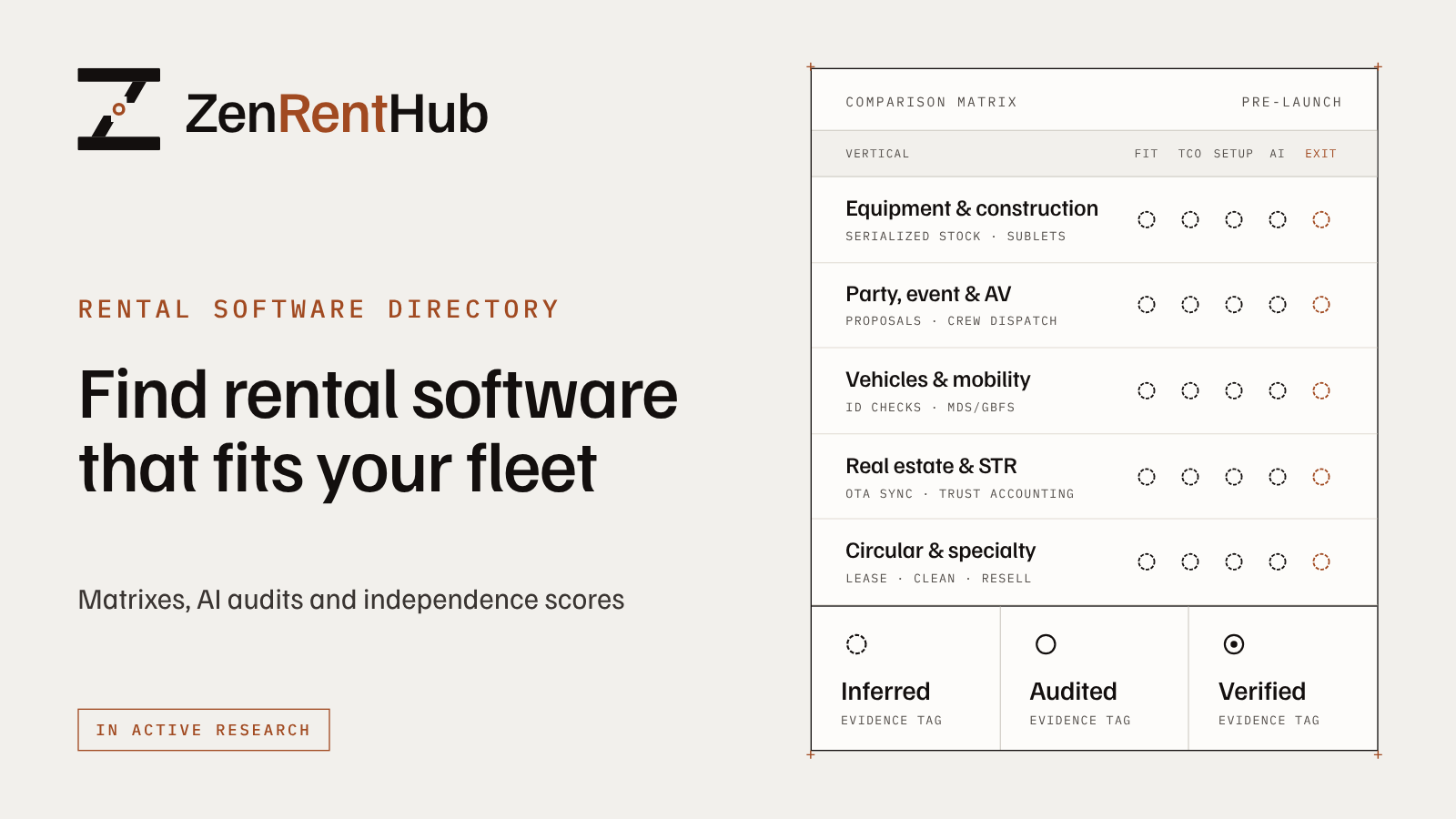
Every directory profile and matrix cell will carry a visible audit timestamp and evidence tag (Inferred, Audited, or Verified). Vendors cannot pay to inflate ratings, hide exit fees, or bypass our data-reach and fallback checks.

Inferred · Evidence Tag
Audited · Evidence Tag
Verified · Evidence Tag
For Aspiring & Existing Rental Operators

Get Early Access to the Directory

Join the waitlist to unlock the v1 comparison matrixes when we launch—and immediately receive our Rental SaaS Portability & Fallback Checklist (covering cold backups, offline check-in checks, and vendor exit questions).

For Rental Software, Telematics & AI Vendors

Submit Your Platform for Review

Want your software included in our v1 comparison matrixes? Submit your product profile, pricing tiers, API/MCP documentation, and data-portability specs now so our analysts audit accurate, up-to-date details.

07 // Frequently Asked Questions

Frequently Asked Questions

01

1. Who is the ZenRentHub Software Directory built for?

It is built specifically for both aspiring entrepreneurs launching their first rental operation and established multi-branch operators across five core sectors: equipment and construction, party and event/AV, vehicles and shared mobility, short- and long-term real estate, and specialty circular-economy or medical rentals.

02

2. How is this different from generic software review sites?

Generic B2B directories group software by surface-level features and rely heavily on paid placement or unverified user reviews. ZenRentHub organizes tools by physical rental mechanics (like subrentals, workshop holds, turn/repair loops, and CAM reconciliation), verifies AI and API claims against actual documentation, and grades vendor lock-in risk.

03

3. What does “Technical Independence” mean for my rental business?

Technical independence means no single software vendor can freeze your operations, trap your customer payment tokens, or hold your historical data hostage. We score platforms on export completeness, self-serve APIs, accounting/payment decoupling, and offline mobile reliability - while giving you practical backup SOPs.

04

4. Can software vendors pay for higher rankings or “Verified AI” badges?

No. Our comparison matrixes and verification tiers (Inferred, Audited, and Verified) follow strict editorial separation. Vendors can submit documentation for free through our Submissions Center to ensure their technical specs are reviewed accurately.